What Makes an Exhibition Stand Attractive to Visitors at the NEC? A successful exhibition stand…
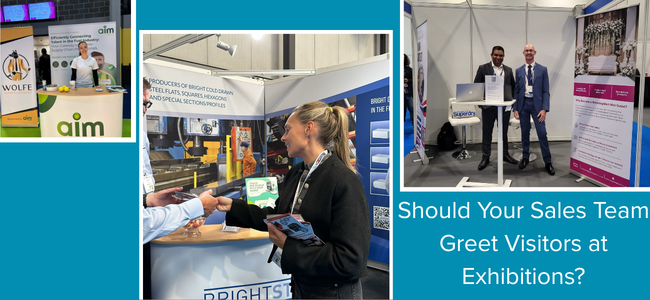
Should Your Sales Team Be Greeting Visitors at Exhibitions?
Should Your Sales Team Be Greeting Visitors at Exhibitions?
Your sales team are some of the most valuable people in your business. Yet at many exhibitions, they spend the first few hours of every show day welcoming visitors, handing out brochures and making coffee for people who have simply wandered onto the stand out of curiosity. It looks productive, because everyone is busy from the moment the doors open. But busy and productive are not the same thing, and if you have ever watched your best salesperson explain where the toilets are while a genuine buyer walks straight past your stand, you already know there is a problem worth solving.
In this guide, we look at why so many of the most successful exhibitors at events across the country, including the major shows at the NEC, deliberately separate the job of greeting visitors from the job of selling to them. We also look at how the right combination of professional exhibition staff, dedicated lead-generation staff and hospitality support can transform the return on investment from your next event, without asking your sales team to do a single thing outside their expertise.
A Familiar Scene You’ve Probably Lived Through
There’s a scene that plays out at exhibition halls up and down the country every single week, and once you notice it, you start seeing it everywhere.
The stand looks fantastic. Months of planning have gone into the graphics, the lighting has been carefully thought through, and the meeting area has been set up and reset three times until it looked exactly right. The sales team arrive early on the first morning, coffee cups in hand, full of energy and optimism about the conversations they hope to have over the next two or three days.
Then the doors open.
The first visitors start wandering through the aisles, and almost immediately, everyone on the stand becomes busy. One member of the sales team steps forward to welcome people in. Another starts handing out brochures to anyone who slows down near the stand edge. Somebody disappears to make a coffee for a visitor who has just introduced themselves, while another colleague spends time explaining where the product demonstration is later that afternoon.
Before long, every single person is occupied doing something.
From the outside, the stand looks like a success, because there is activity everywhere you look. But the real question, and the one very few exhibitors ever stop to ask, is whether everyone on that stand is actually doing the job they are best qualified to do.
Being Busy Isn’t the Same as Being Effective
It is something we think about often, having worked alongside exhibitors across hundreds of events over the years, because the gap between looking busy and being productive is far wider than most businesses realise. The most experienced salesperson in your organisation, the one who can read a room, ask the right question and close a deal that has taken months to build, may have just spent an entire hour talking to visitors who were only there to collect a free pen and a brochure. Meanwhile, a genuine decision maker with real budget and a real problem to solve walked past the stand because nobody was free to start a conversation with them.
That is rarely anybody’s fault. Nobody sets out to waste their best people’s time. It is simply what happens naturally when everyone on a stand tries to do everything at once, because there is no clear plan for who does what.
The trouble is that exhibitions generate dozens of small tasks that all feel equally urgent in the moment. Visitors need greeting. Refreshments need offering. Literature runs out and needs replenishing. Demonstrations need introducing. Appointments need to be booked in and managed. Leads need to be captured properly so they can be followed up after the show. None of these jobs can be ignored, and yet almost none of them actually require your most experienced, most expensive salesperson to be the one doing them.
If your Head of Sales earns their reputation by building long-term relationships, understanding complicated customer requirements and negotiating six-figure contracts, does it really make sense for them to spend the first hour of every show day directing passers-by towards the coffee machine? It’s an uncomfortable question, mainly because most businesses have never actually stopped to ask it. Instead, there’s an assumption that exhibiting simply means everyone mucks in together and helps wherever they’re needed. There is certainly value in that kind of teamwork. But there is even more value in recognising that different people bring different strengths, and that those strengths are wasted when everyone is asked to do the same job.
What This Actually Costs You
The financial reality of exhibiting is often overlooked in all the busyness. Stand space, build costs, travel, accommodation and staff time all add up quickly, and for many businesses a single event represents one of the largest marketing spends of the year. Every hour your senior sales team spend on tasks that don’t require sales expertise is an hour of that investment quietly leaking away.
There is also a subtler cost that rarely gets discussed: fatigue. Exhibitions are physically and mentally demanding. Standing for eight hours a day, repeating the same introduction dozens of times, and switching constantly between small talk and serious sales conversation takes a real toll. When your sales team are also responsible for greeting, hosting and general stand admin, they arrive at the important conversations already tired, and that shows. A buyer who has waited while your salesperson finished making someone else’s coffee is not getting the sharpest, most engaged version of that person.
None of this is about your team not working hard. It’s about whether that hard work is being pointed at the right target.
Separating the Roles: What the Best Exhibitors Actually Do
Rather than expecting your sales team to welcome every passer-by, answer every simple question and deal with stand administration, many of the most successful exhibitors build a small, deliberately structured team where every single person has a clearly defined purpose.
Professional exhibition staff are trained to create a warm, confident first impression the moment someone steps onto your stand. They know how to strike up a natural conversation, gauge genuine interest quickly, and either answer a simple query themselves or hand the visitor smoothly across to the right person. They are the friendly, approachable face of your brand, and because greeting people is their entire focus, they do it consistently well throughout the day, not just in the first hour before everyone gets swallowed up by other jobs.
Lead generation staff take this a step further. Their job is to identify genuine opportunities within the flow of visitors, ask the right qualifying questions, and capture accurate, useful information that your sales team can act on after the show. A well briefed lead generation specialist can tell the difference between someone gathering brochures for a college project and a procurement manager with a live budget, and they know exactly how to move the second person towards a proper conversation without pressuring the first.
Hospitality staff keep the whole stand running smoothly in the background. They make sure drinks are offered, meeting areas stay tidy and presentable, and visitors who are waiting for a specific conversation are looked after in the meantime. It sounds like a small thing, but a stand that feels calm, organised and well hosted makes a lasting impression, and it frees every other member of the team to focus on the job they are actually there to do.
And then there is your own sales team, spending their time exactly where it creates the greatest value: having meaningful, unhurried conversations with people who are genuinely interested in doing business with you. Instead of being pulled into ten different directions, they can concentrate fully on understanding a prospect’s needs, answering detailed technical questions, and moving real opportunities forward.
What Good Looks Like in Practice
Picture the same stand from the beginning of this article, but structured differently. As the doors open, professional exhibition staff are already greeting visitors warmly and consistently, all day, every day of the show. Lead generation staff are moving through those conversations, asking a handful of well chosen questions and quickly identifying who has a genuine need. Hospitality staff are keeping the coffee flowing and the stand looking sharp without anyone needing to think about it. And your sales team are sitting down with pre-qualified visitors, having the kind of focused, valuable conversations that actually move deals forward.
The stand still looks busy from the outside. It still feels energetic and welcoming. The difference is that every single person on it is now working to their strengths, and the visitors who matter most are getting the attention of your most capable people, rather than whoever happened to be free.
Building the Right Team for Your Next Event
This does not mean your sales team should disappear into a back office for the duration of the show. Far from it. Their presence, expertise and personality are exactly what turns a good lead into a signed contract. The point is simply to protect their time so it is spent on conversations that genuinely require it, rather than on tasks that anyone properly briefed could handle just as well, if not better.
For many exhibitors, this means bringing in experienced exhibition staff and lead generation specialists alongside their own sales team, rather than trying to stretch existing staff across every role on the stand. It is a change in approach rather than a change in ambition, and it is one of the simplest ways to genuinely improve the return you get from every show you attend.
If you are planning your next exhibition and want to make sure your sales team spend their time where it counts, it is worth having an honest conversation internally about who is doing what on the day, well before the doors open. The stands that get this right rarely look any different to the untrained eye. What is different is what happens after the show, when the follow up calls start and it becomes clear just how many of those conversations were the right ones.

Related Posts