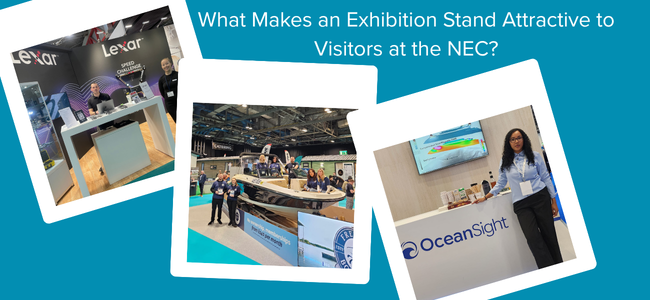
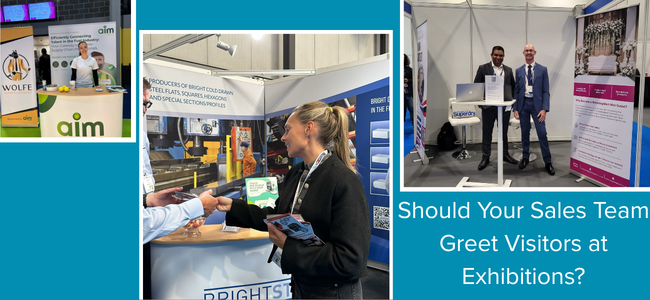
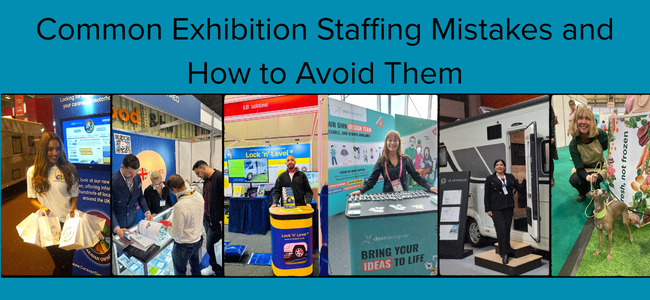
What Makes an Exhibition Stand Attractive to Visitors at the NEC? A successful exhibition stand…
Why People Still Stop at Exhibition Stands
Why People Still Stop at Exhibition Stands
Walk around any exhibition at the NEC Birmingham today and it is impossible not to notice how much exhibitions have changed over the years. Stands are bigger, screens are brighter, technology is everywhere and businesses put enormous effort into creating visual impact. Entire halls are designed to compete for attention from the moment visitors walk through the doors.
Yet despite all of that, there is something interesting about exhibitions that has never really changed at all, people still behave exactly like people.
They still slow down when something catches their curiosity. They still respond to warmth, energy and conversation. They still remember how somebody made them feel far more than they remember a slogan printed on a backdrop.
That is probably why exhibitions continue to work so well, even now, they are one of the few places where businesses and people still meet face to face in a genuine way. In a world where so much communication happens through screens, exhibitions still create real human interaction.
Our team were recently discussing how similar modern exhibitions actually are to events from well over a century ago. If you think back to The Great Exhibition in London in 1851, it was not simply rows of products people came to see. Visitors travelled to experience ideas, innovation and atmosphere. The exhibitors who stood out were not necessarily those with the biggest displays, but the ones who created interest and interaction around what they were doing.
That still applies today, the technology may have evolved, but human nature has not changed nearly as much as we think.
Why Visitor Behaviour Matters More Than Stand Design
Businesses often spend months planning exhibition stands. They discuss graphics, lighting, layouts, flooring, furniture and digital displays in huge detail. All of those things matter, of course, because presentation creates the first visual impression.
But exhibitions are not static environments. People do not experience a stand in the same way they experience an advert in a magazine.
They experience it emotionally.
That is why two stands with very similar products can have completely different results. One may feel busy, engaging and welcoming while another feels strangely flat, even if visually it looks impressive.
Usually, the difference comes down to atmosphere.
Visitors are constantly making subconscious decisions as they walk around exhibitions. Without even realising it, they are asking themselves questions such as:
Does this feel approachable?
Do these people look interested in speaking to me?
Can I quickly understand what this company does?
Would I feel comfortable stopping here?
The answers to those questions are rarely created by signage alone. More often, they are created by the people on the stand.
At the NEC, where exhibitions can attract thousands upon thousands of visitors in a single day, this becomes even more important. Visitors are surrounded by stimulation constantly and after a while, many stands begin to blur together visually. What cuts through is energy, interaction and human engagement.
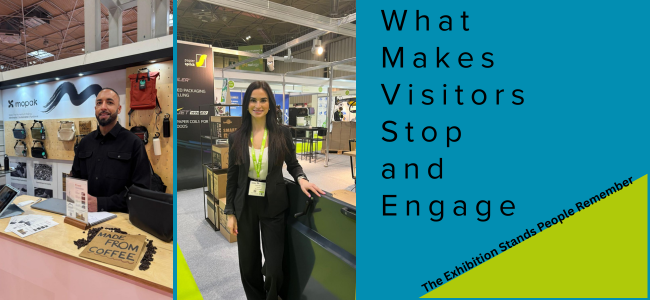
The Exhibition Stands People Remember Usually Feel Different
If you spend enough time at exhibitions, you start noticing that the stands people gather around are not always the largest or most expensive.
Sometimes the busiest stand in the hall is relatively simple, but it has something else that draws people in. There is movement around it. Conversations are happening naturally. Visitors seem comfortable there. The atmosphere feels alive.
That energy is difficult to manufacture artificially because people instinctively recognise when interaction feels genuine.
A stand where exhibition staff are engaged, welcoming and proactive creates a completely different feeling from one where people are standing around waiting for somebody to approach them.
Visitors notice those differences immediately.
They notice when staff are smiling naturally rather than mechanically. They notice when conversations seem relaxed and enjoyable rather than scripted. They notice whether people appear genuinely interested in interacting or simply waiting for the day to finish.
This matters because exhibitions are often emotionally driven environments. Even in highly corporate sectors, people still respond emotionally first and logically second.
They remember:
- whether they felt welcomed
- whether somebody acknowledged them
- whether the stand had good energy
- whether conversations felt easy and natural
That emotional impression stays with people much longer than businesses sometimes realise.
Why Human Interaction Still Matters So Much
There is a tendency to think that technology has replaced parts of the exhibition experience, but in many ways it has actually increased the importance of human interaction.
Visitors can research products online.
They can compare suppliers online.
They can watch demonstrations online.
What exhibitions still provide is human connection.
That is why people continue attending events at venues like the NEC Birmingham year after year. They want to experience brands properly. They want conversations. They want to ask questions naturally and gauge whether a company feels right for them.
This is where exhibition staff become incredibly important.
Not because they are simply there to hand out brochures or stand beside a display, but because they shape the experience visitors have with the brand itself.
A good exhibition team creates confidence around a stand. They help visitors feel comfortable enough to stop and engage. They create momentum and atmosphere. They keep the stand feeling active rather than static.
Most importantly, they help interactions feel human.
That sounds simple, but it is surprisingly powerful.
The Real Difference Between Engaging Staff and Passive Staff
One of the biggest differences you notice at exhibitions is not actually between stands. It is between the attitudes of the teams working on them.
Some exhibition staff naturally create interaction around them. They stay aware of visitors, they acknowledge people walking past, and they understand how to begin conversations in a relaxed and approachable way.
Others wait passively for visitors to do all the work.
The effect this has on footfall is enormous.
People are naturally drawn towards activity and confidence. When a stand feels welcoming and energetic, visitors are more likely to approach because somebody else has already made the interaction feel safe and comfortable.
Equally, visitors tend to avoid spaces that feel awkward or closed off.
It is interesting how often businesses focus heavily on visual design while underestimating the influence staff behaviour has on the overall atmosphere. Yet in reality, the people on the stand often determine whether the stand feels approachable at all.
What Happens When a Stand Gets Busy
One thing many exhibitors do not fully think about beforehand is what happens once engagement starts increasing.
A busy stand should feel exciting, but it can quickly become stressful if there is no structure or awareness behind it.
At large NEC exhibitions especially, there are moments when visitor flow changes very quickly. A stand can go from relatively calm to extremely busy in a matter of minutes.
Visitors notice immediately if:
- nobody greets them
- staff become flustered
- conversations feel rushed
- people are left standing awkwardly
- the atmosphere becomes chaotic
What experienced exhibition staff do well is maintain the feeling of welcome even during busy periods, which is a genuine skill.
People are often surprisingly patient if they feel acknowledged. Even a quick smile or simple “we’ll be with you shortly” changes the entire experience because visitors still feel seen rather than ignored.
Again, this comes back to human behaviour, exhibitions are emotional environments as much as commercial ones.
The Best Exhibition Stands Feel Comfortable
One thing that often gets overlooked in exhibition planning is comfort, not physical comfort necessarily, although that matters too, but emotional comfort.
Visitors want to feel comfortable approaching a stand, able to ask questions and spend time without pressure. That feeling usually comes from atmosphere rather than design.
The best exhibition stands rarely feel overly corporate or intimidating, they feel more open, relaxed and welcoming. Visitors feel they are being invited into a conversation rather than targeted by a sales process.
This is where the phrase “creating a buzz” becomes important, a buzz is not simply noise or crowds. It is a feeling. It is the sense that something positive is happening around a stand. Visitors can feel it instinctively.
And usually, it is created by people rather than products.
Why Exhibitions Still Work So Well
For all the changes in marketing and technology, exhibitions remain incredibly powerful because they satisfy something fundamentally human.
People still enjoy discovering things in person.
They still value face-to-face interaction.
They still trust real conversations more than polished advertising.
That is why exhibitions continue to matter so much for businesses across the UK.
And it is also why exhibition staff have such an important role within that experience.
At NEC Exhibition Staff, we see this every day. The stands that perform best are not always the loudest or the most expensive. They are often the ones where visitors feel genuinely welcomed, engaged and included in the experience.
Because ultimately, exhibitions are not remembered because of flooring or furniture. They are remembered because of moments such as conversations, atmosphere, energy and interaction and despite how much exhibitions have evolved over the years, that part has never really changed at all.

Related Posts