Should Your Sales Team Be Greeting Visitors at Exhibitions? Your sales team are some of…
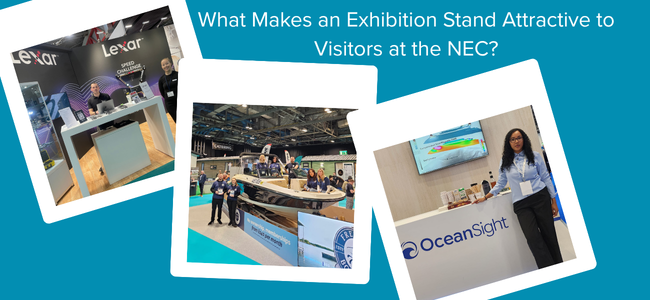
What Makes an Exhibition Stand Attractive to Visitors at the NEC?
What Makes an Exhibition Stand Attractive to Visitors at the NEC?
A successful exhibition stand needs to do more than look good
When you are exhibiting at the NEC Birmingham, you are competing for something far more valuable than floor space: you are competing for attention. Visitors may pass hundreds of businesses during a single day, so your stand needs to give the right people a reason to stop, understand what you offer and decide that a conversation is worth their time.
That does not necessarily mean having the largest stand, the most expensive technology or the biggest giveaway. What attracts visitors depends heavily on what you are trying to achieve. A business looking for qualified sales leads needs a very different stand experience from a company launching a product, demonstrating equipment or entertaining existing clients.
So, before thinking about colours, screens and furniture, there is a more important question to answer: what do you actually want your exhibition stand to achieve?
What Do You Want to Achieve From Your NEC Exhibition Stand?
It sounds obvious, but your commercial objective should shape almost every decision you make about your exhibition presence.
If your priority is lead generation, you need a stand that makes starting and managing conversations easy. Visitors should understand what you do quickly, while your team needs a straightforward way meeting good prospects and capturing useful information.
If you are launching a product, your requirements could be completely different. You may need demonstration space, screens, seating or an interactive area where people can experience the product rather than simply hear about it.
For businesses using an exhibition to meet existing customers, a constantly busy stand may not even be the objective. You might achieve far more value by creating comfortable areas where your team can have meaningful conversations with important clients.
This is why footfall alone should never define exhibition success. A stand attracting 500 visitors is not automatically performing better than one attracting 100 if those 100 include exactly the decision makers the business wanted to meet.
The question should therefore change from “How can we attract more people?” to “How can we attract more of the right people?”
Why Would a Visitor Stop at Your Exhibition Stand?
Put yourself in the visitor’s position for a moment. You enter a busy NEC exhibition hall surrounded by graphics, screens, demonstrations, conversations and promotional messages. You probably have businesses you already intend to visit, but you are also looking around for something interesting or relevant.
You cannot stop everywhere, which means you make quick decisions.
One of the strongest reasons to stop is clarity. If a visitor can quickly understand what you offer and why it could matter to them, you have already removed an important barrier.
Trying to communicate everything your company does can therefore work against you. A stand covered with lengthy messages, product lists and competing graphics can become difficult to understand. One strong proposition that addresses a recognised customer need is often much more powerful.
Think about the questions your potential customers are already asking. If somebody is looking for a way to reduce production costs, improve efficiency, solve a staffing problem or find new technology, does your stand immediately suggest you have an answer?
An attractive exhibition stand is not simply something people want to look at. It is somewhere the right people believe they should investigate.
Exhibition Stand Design Should Make It Easy to Approach You
A beautifully designed stand can still feel surprisingly difficult to enter.
Large counters across the front, too much furniture or groups of people standing around the entrance can unintentionally create barriers. Visitors may look interested but continue walking because they are unsure whether they are supposed to step inside.
Open layouts tend to make engagement easier because people can move naturally from the aisle into the stand. On a small stand, this may mean keeping the front clear and positioning your key message where it can easily be seen.
Larger exhibition stands require more consideration because several things may be happening simultaneously. You might have demonstrations at one end, meetings at another and hospitality or interactive activities elsewhere. Visitors need to understand where they should go without feeling as though they have entered a maze.
You also need to consider what happens when the stand becomes busy. A demonstration attracting a crowd can be excellent for visibility, but if that crowd blocks your entrance, other potential customers may simply move on.
Good exhibition design therefore considers visitor movement as well as appearance.
Do Interactive Exhibition Stands Attract More Visitors?
Interactive experiences can be extremely effective because they give people a reason to participate rather than simply observe.
A manufacturer might demonstrate equipment, a technology company could offer live product trials, and a consumer brand might use sampling or competitions. Games, challenges and digital experiences can also attract attention when they make sense for the brand and audience.
However, there is an important distinction between attracting visitors and achieving your exhibition objectives.
A racing simulator might create a queue, for example, but if nobody connects that experience to your business, you may have successfully entertained people without generating anything commercially useful.
The strongest interactive stands create a natural bridge between the activity and the conversation that follows. Once someone has watched, tried or experienced something, your team needs to know how to turn their interest into a relevant discussion.
That is particularly important when lead generation is your priority. The interactive element should open the door to the conversation rather than become the entire reason for the stand.
How Do Exhibition Staff Make a Stand More Approachable?
The people on your stand influence whether visitors stop, regardless of how impressive the physical space might be.
Imagine two identical stands. On one, everyone is sitting behind a counter looking at laptops or talking amongst themselves. On the other, the team looks engaged, available and interested in the people walking past.
Most visitors will instinctively find the second stand more approachable.
This does not mean your team should aggressively approach everyone entering the aisle. Exhibition visitors quickly become tired of being sold to, and an overly enthusiastic approach can be just as uncomfortable as being ignored.
Effective exhibition engagement is about reading people. Someone slowing down to look at your product may welcome a simple opening question, while another visitor may want a few moments to browse before speaking.
Your own employees are an important part of this because they bring specialist knowledge that temporary exhibition staff cannot replicate. However, senior salespeople and technical specialists can quickly become involved in detailed conversations. When that happens, somebody still needs to acknowledge the next visitor.
This is where experienced exhibition staff can complement your existing team by welcoming people, beginning conversations and identifying who should speak to whom. Rather than replacing your employees, they can help your specialists spend more time with the visitors who genuinely need their expertise.
If You Want Exhibition Leads, Think About Quality Rather Than Quantity
Lead generation is one of the main reasons businesses invest in exhibiting at the NEC, but counting contact details can give a misleading impression of success.
Collecting 300 email addresses sounds impressive until your sales team discovers that very few of them represent realistic opportunities.
Good lead generation begins with conversation. Your stand team needs to understand who you want to meet and what information makes somebody an interesting prospect. They can then ask appropriate questions naturally rather than simply scanning every badge that passes the stand.
It is also worth deciding before the exhibition what information your sales team will need afterwards. A name, company and email address provide very little context when somebody is trying to follow up several days later. A short note about what the visitor discussed, what interested them and what should happen next makes that lead considerably more valuable.
Your exhibition strategy should therefore extend beyond getting somebody onto the stand. You need to consider the entire journey from first glance to first conversation and eventually to follow-up.
Are Giveaways and Competitions Enough to Make People Stop?
Giveaways, refreshments and competitions remain popular because they can provide an easy reason for someone to approach a stand. The difficulty is ensuring they attract people for the right reason.
Free coffee may create plenty of footfall, but the busiest person on your stand could end up being whoever operates the coffee machine. A high-value competition might produce hundreds of entries from visitors who are more interested in the prize than your company.
That does not make these tactics ineffective. It simply means they should support your objective rather than exist separately from it.
A useful branded item connected to your industry may keep your business in someone’s mind after the event, while a competition based around your product can provide a natural opportunity for discussion. The important question is whether the activity helps move visitors towards the commercial outcome you want.
How Much Does Stand Size Matter at an NEC Exhibition?
A large stand certainly creates opportunities, but size alone does not guarantee success.
Larger stands allow you to create different zones for demonstrations, meetings, hospitality and visitor engagement, although they also create greater staffing and management requirements. A large space with too few people can feel surprisingly empty, while poorly planned activity can result in one area becoming overcrowded and another being ignored.
Smaller stands have different challenges, but they can perform extremely well when their message is clear and their team is proactive. Without space for elaborate experiences, every element has to work harder, which can actually encourage businesses to become much clearer about what matters.
Whatever the size, your stand should feel appropriate to the experience you want visitors to have.
Keep Your Exhibition Stand Engaging Throughout the Day
One element that rarely appears on a stand designer’s plan is energy.
Exhibition days can be demanding, particularly when your team has travelled, attended evening networking events and spent several hours speaking to visitors. By mid-afternoon, the difference between an energetic stand and a tired one can become noticeable.
The visitor arriving late in the day, however, may be exactly the person you wanted to meet.
Appropriate staffing levels and sensible breaks therefore matter. Your team needs enough capacity to keep welcoming visitors while colleagues take breaks or become involved in longer conversations.
If you have a larger stand, clear responsibilities can also help. When everyone knows who is greeting, demonstrating, capturing leads and handling detailed enquiries, visitors receive a much more consistent experience.
Make Your NEC Exhibition Stand Attractive to the Right Visitors
There is no universal formula for creating the perfect exhibition stand because different businesses attend the NEC for different reasons. A company demonstrating machinery has different requirements from a software provider, consumer brand or professional services business.
What successful stands tend to share is a clear purpose.
Your design, messaging, activities and people should all support what you want visitors to do. If you want leads, make conversations and data capture easy. If you want product awareness, make the product impossible to overlook. If you want meetings with key customers, create an environment where those conversations can happen comfortably.
Before approving your next NEC exhibition stand, imagine seeing it for the first time as your ideal customer.
Ask yourself whether you could quickly understand what the company offers, whether there is a genuine reason to stop and whether it is obvious what happens once you do.
If all three answers are yes, you have moved beyond simply creating a stand that looks attractive. You are creating an exhibition experience designed around the people you actually want to meet and the commercial results you want to take back to your business.

Related Posts